

School days, school days, dear old gold-en rule-days . . .
Yup, school days are back. Jacksonville’s streets and highways once again buzz with yellow buses and individual cars ferrying children off to houses of learning. More traffic congestion.
One wonders about the young people in transit, all 125+ thousand of them, particularly since the cost of school lunch made headlines recently. The Duval County school board voted to increase lunch prices, though knowing precisely how many students attending public schools must pay the increase is difficult.
Breakfast, it seems, is free for every student, and lunch is free for students attending schools that participate in the Community Eligible Provision program (CEP). According to JaxToday, roughly 70% of Duval County public schools participate in CEP, and individual students whose families are enrolled in the Supplemental Nutrition Assistance Program (SNAP, formerly known as food stamps) also qualify for free lunch, though those SNAP numbers are in free fall.
You will remember that Congress last summer adopted dramatic funding cuts to SNAP, the full effect on children not fully known. Early data analysis, including effects on Floridians, has begun. It’s not pretty.
Images of Oliver Twist pleading with sir for some more gruel springs to mind.
Grim Consequences
Arguably our country’s “most important anti-hunger program,” SNAP’s funding cuts are resulting in dramatic decreases in participation rates, especially among children. Consequently, one wonders how Duval County families with school-aged children are faring, especially since early national data is daunting.
Between summer 2025 and April 2026, 4.5+ million Americans, 1.5 million of whom are children, lost financial assistance to help put food on the table. Among these are 600,000+ Floridians, with the precise number of Florida’s children not known. Almost 20% fewer people participate statewide following the introduction of first year funding cuts. One wonders: what happened to them?
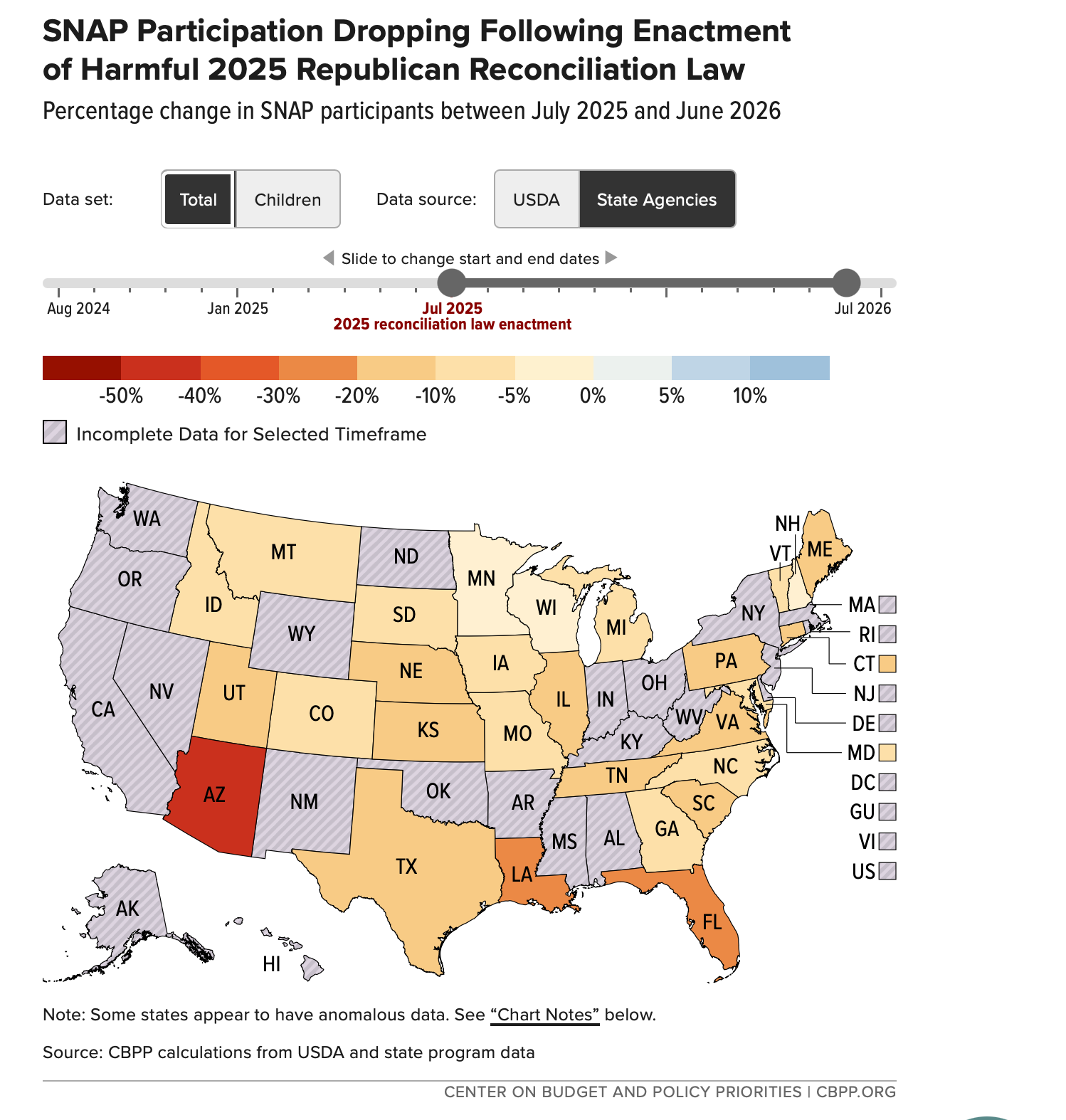
23,000 minus ?
Based on 2023 data, Mayor Donna Deegan’s transparency dashboards indicate that 160,000 individuals living in 57,000 Duval County households relied on SNAP each month that year, with every county zip code included. If Florida’s participation rate declined 20% by April 2026, we can guess that Duval County’s participation rate declined likewise.
Before this dramatic decline, Duval County’s public school system estimated that 23,000 local students were enrolled in SNAP. We can guess that 20% fewer children now participate. Do the math.
Though our elected Congressional representatives say that they did not intentionally target children, they did with intentionality make these dramatic, even draconian, funding cuts to SNAP. Kids, just afterthoughts. Collateral damage.
But one wonders. What’s happening to these people? Especially these children.
Jacksonville Cares
Last November, early reality began to set in when a prolonged federal government shutdown abruptly suspended SNAP funding. Mayor Deegan and City Council responded. The Mayor created the Duval Care Coalition and City Council passed emergency legislation to provide $200,000 to Feeding Northeast Florida. At the time, Feeding Northeast Florida’s CEO Susan King said “people are afraid.”
The Mayor’s response and the 2025 emergency legislation proved our elected leaders can care, and sometimes understand the human consequences of eliminating food assistance. Their actions, though laudable, were in response to an abrupt SNAP shutdown.
How will they, and we, respond to what we know is coming: a steady dismantling of food assistance for hungry children and their families? We know with certainty that participation rates will steadily decline, and that an increasing number of families and children will go hungry.
Their experience and our reaction bears watching, particularly as our local City Council attempts to make dramatic cuts to local public services.
As you sit in school traffic, ask yourself, who cares for these children?
Ron DeSantis has lived a charmed life on the taxpayer's dime for 8 years. Yet, DeSantis declined for four years to participate in the federal Summer Electronic Benefit Transfer (EBT) program, known as "Sun Bucks," leaving hundreds of millions in federal food assistance unused for low-income children. Florida turned down roughly $250 million to $259 million in federal funding available for EACH summer cycle. Over 2 million low-income school-aged children missed out on receiving $120 per child in direct grocery benefits. This worsened food insecurity for eligible school-age kids while hurting the bottom line of Florida grocery retailers who would have processed the benefits. The Legislature actually embraced the program and wrote enabling legislation, but Porky vetoed it three years in a row -- and this year the Legislature didn't even try.
So, schools days may mean more food for kids who leave the table hungry because they don't dine at the Florida White House or on a lobbyist's tab.
“Nature is cruel, but we don’t have to be.” Temple Grandin.