
"The Only Thing We Learn from History . . .
We Never Learn from History," Professor Ragsdale

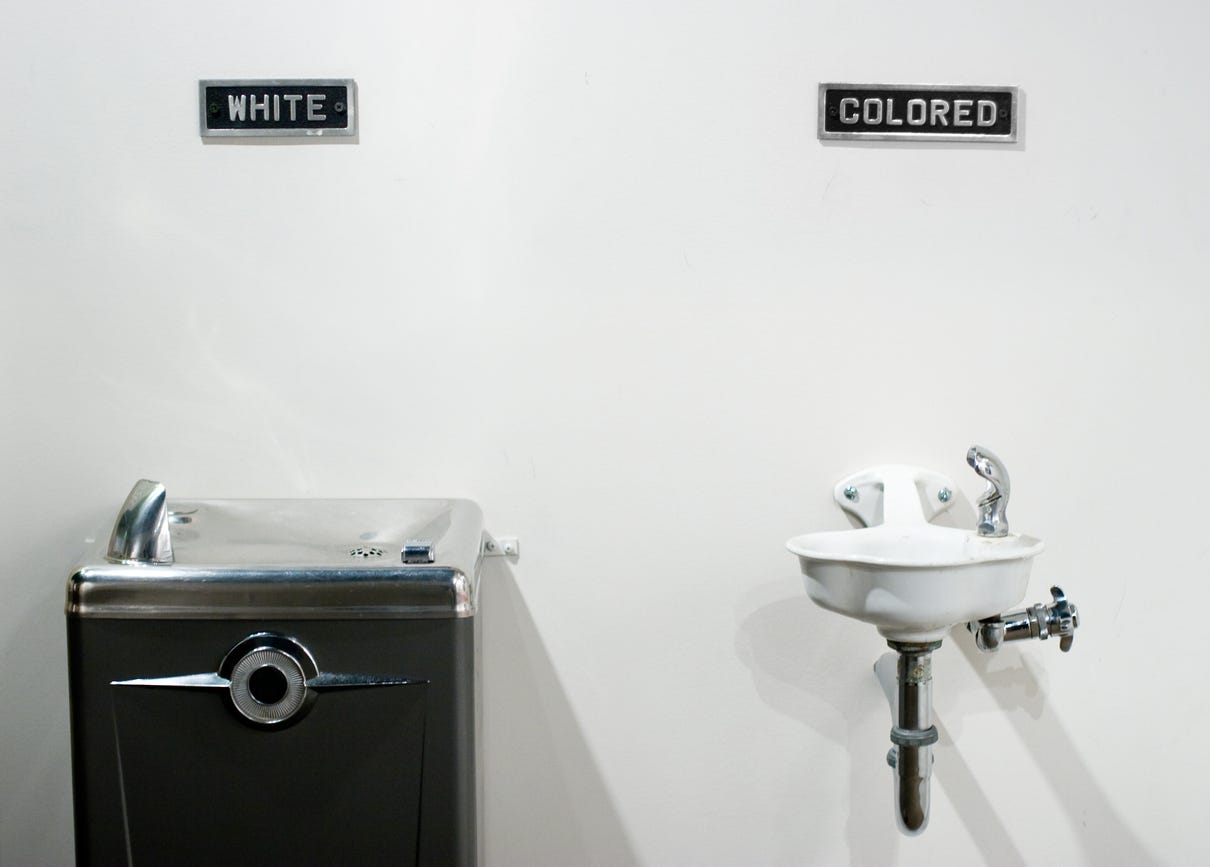
Some folks remember, some folks forget, some folks never knew
“It wasn't really that bad, was it?” my friend asked.
We were standing in front of a segregated water fountain, part of a Jim Crow era display in the Civil Rights Institute located across from downtown Birmingham’s 16th Street Baptist Church. That one. Where four little girls my age were murdered when a bomb Alabama Klan members planted exploded some 60 years ago while I was praying in Sunday School three counties away. We heard it told on the radio on our car ride home.
The child in me paused. “Yes. It was that bad.”
I wondered then and now how it was my friend didn’t know about Jim Crow. Her question was genuine; she was seriously incredulous. Being younger and not from the Deep South, she simply had no experience living in a racially-segregated society mandated by state law. The display of cultural artifacts startled her, made her wonder when this happened, how it happened, why some folks thought it normal and just the way of the world.
Do historical images and cultural artifacts actually make any difference to the human present and future? teach any lessons? inform? shape any values and attitudes? make any difference in how folks behave now and in the future? Clearly we must think so, or else we wouldn’t fight so much about who gets to tell what story. And where that telling gets told. In the public square or in some private out of the way location?
The only thing we learn from history, Western Civ history professor Hugh Ragsdale told his college first-year students, is that “we never learn from history.” In some sense he's right: humans seem to repeat the same old atrocities, generation after generation, and this despite all those religious teachings across the planet instructing us with the big brain to be kind. Ragsdale never explained, despite his odd “dictum,” why he studied history. Maybe he thought it important to tell about the past even if that telling changed nothing. Or maybe he hoped his students would learn something positive about human resilience in the face of extraordinary adversity, especially atrocities perpetrated by humans upon humans.
The U.S. Civil Rights Trail: A story about hope
The 16th Street Baptist Church and the Civil Rights Institute are part of Alabama’s Civil Rights Trail, the precursor to the U. S. Civil Rights Trail established in 2018. A walking and driving tour, the U. S. Trail takes folks through a visit of significant landmark sites—churches like 16th Street Baptist, courthouses, schools, and museums—located in mostly Southern states that, according to the Trail’s website, “played a pivotal role in advancing social justice in the 1950s and 1960s, shifting the course of history.”
Lest we forget, the website includes music, photographs, video, and a podcast of interviews and stories about our Civil Rights History. A comfort to a generation of Southerners whose memories are dimming and a reminder that average folks’ civic sacrifices matter, that people’s contributions indeed can make for a more humane society.
Jacksonville’s Trail
In spring 2018, then City Council president Anna Brosche appointed a group of local citizens to a Civil Rights History Taskforce. Unanimously approved by City Council, the Task Force’s creation apparently stemmed from a 2018 Florida-Times Union editorial lamenting Jacksonville and Florida’s exclusion from the recently announced U. S. Civil Rights Trail.
The Task Force was charged with recommending how the City of Jacksonville could “better reflect and educate” local citizens and visitors alike about Jacksonville’s “rich civil rights history,” an education that would lift up the contributions local people and places made toward creating a more humane society. Local citizens makin’ a difference.
These 27 Task Force citizens released their report in June 2018. They compiled a local “Civil Rights History Timeline” which begins in 1838 with the founding of Bethel Baptist Institutional Church and ends 180 years later with mention of Jacksonville’s Hope and History Mural. The mural itself, located on A. Phillip Randolph, is a study in hope, memorializing Ax Handle Saturday, that infamous August 27, 1960 afternoon when an angry mob of some 200 white men with local police complicity used ax handles and baseball bats to beat a group of black youth protesting racism and segregation.
The Task Force called the mural “an attempt to inspire . . . the community to properly reflect on the past in order to inform and encourage a more just future.” They recommended the Timeline be added to the City’s website and that Jacksonville “participate in the U. S. Civil Rights Trail,” which in and of itself serves as an opportunity to reflect. Whether or not that reflection might “inform and encourage a more just future,” well, we hope so.
Hope and History. History and Hope.
To date, there is no evidence that the City’s website (https://www.coj.net) recognizes the Timeline, nor is there evidence that we have joined the U. S. Civil Rights Trail, though folks can find some local Civil Rights History landmarks at Visit Jacksonville (https://www.visitjacksonville.com/blog/civil-rights-landmarks-in-jacksonville/), and some Florida communities such as St. Augustine and Mims have been added.
Let’s hope we can do better.
Next time you see City Council members, ask them if they know about the Civil Rights History Taskforce Report, the U. S. Civil Rights Trail, and Jacksonville’s possible inclusion.
Visit the Trail
You can take visual tours of the U. S. Civil Rights Trail including Florida through these links:
https://civilrightstrail.com/state/alabama/
https://civilrightstrail.com/wp-content/themes/uscrt/assets/pdf/Florida_itinerary.pdf
Sources:
https://thecoastal.com/flashback/ax-handle-saturday-jacksonvilles-ugliest-hour/
https://www.news4jax.com/jax-best/2021/06/21/jacksonvilles-best-public-art-hope-and-history/
https://thecoastal.com/culture/art/mural-spotlight-hope-and-history-by-local-students/
Thank you Thank you Sherry for casting light on a painful part of our nations history and the role Jacksonville has played in it . We still have so much work to do . Your story inspires and challenges
I pray we can honor Professor Ragsdale by proving him wrong ,....l and learn from our past at last!
Sherry - I appreciate your proud Birmingham roots and the last 2 articles you have shared.
There are many places that leave an indelible mark - if one experiences them with an open mind.
One of the most impactful places I have ever visited was Kelley Ingram Park in Downtown Birmingham to see the Civil Rights Sculptures and to remember the Sixteenth Street Baptist Church bombing that killed Addie Mae Collins, Carole Robertson, Cynthia Wesley and Denise McNair. The visit provided a powerful and memorable introduction to the African American fight for freedom in the southlands.
Starting again in Birmingham, we returned a few years ago to be further educated. After seeing even more tributes, memorials and churches in Birmingham, we drove to Selma to learn about the 1965 events of the Civil Rights Movement. From Selma, we drove the Selma to Montgomery National Historic Trail that was walked during the Voting Rights March - from Selma's Edmund Pettus Bridge all the way to the steps of the Alabama State Capital in Montgomery.
Staying for the night - we were able to spend time at The Monument at the Peace and Justice Memorial Center and at The National Memorial for Peace and Justice and The Legacy Museum.
The events that connect Birmingham, Selma and Montgomery have been illuminated as powerfully and as important as any 9/11 Memorial in Manhattan and Shanksville, PA and as emotionally draining as the Holocaust Museum in Washington D.C.
Those responsible for telling the right stories should be incredibly proud.
They have asked the country, and the world, to face the facts.
Thank you very much - RP
PS - just think - the National Memorial for Peace and Justice is now known as the "Lynching Museum" - if that doesn't tell you, and show you, the truth, maybe nothing will.